By: Thomas Park, Staff Writer
You might have heard of the many sports teams at Great Oak— football, soccer, basketball, baseball, field hockey, cross country, track — the list goes on. If you can name a sport or activity, chances are you can do it here. Most of these competitive teams, however, revolve around athletics. But there are also several other clubs on campus that aren’t physically demanding yet still thrive on competition, such as Mock Trial and Science Olympiad. Among them is another, smaller club that participates in academic competitions each year.
Meet Great Oak’s Academic Decathlon team, a stellar group that competes annually in the nationwide Academic Decathlon competition (groundbreaking, I know). Throughout the year, the club meets twice a week to study the various subjects featured in the Decathlon. This all culminates in a series of final tests during the winter, where participants earn points for their team and ultimately compete for victory against other Decathlon teams. The competition begins at the county level before progressing to state and national levels, with the winning teams advancing upward. For many students, it’s a great opportunity to experience competition without the physical demands of sports, while still enjoying the teamwork and challenge that comes with any competitive pursuit.
At a first glance, however, the club might seem intimidating. With a name like “Academic Decathlon,” some students might have a few questions about joining: Do I need good grades to get into the club? What’s the time commitment? How can studying be fun?
Take it from me —I competed on Great Oak’s 2025 Academic Decathlon team last year and attended most of the meetings throughout the season. It turned out to be one of the most enjoyable experiences I’ve ever had in school. I spent time with people who are now close friends while learning about fascinating subjects I never would have explored otherwise. The meetings can be serious at times, but by the end, we’re always having fun.
But don’t just take my word for it. To gain more insight into how the Academic Decathlon team operates, I’ve interviewed one of the club presidents—and my team captain—Luke Johnson.
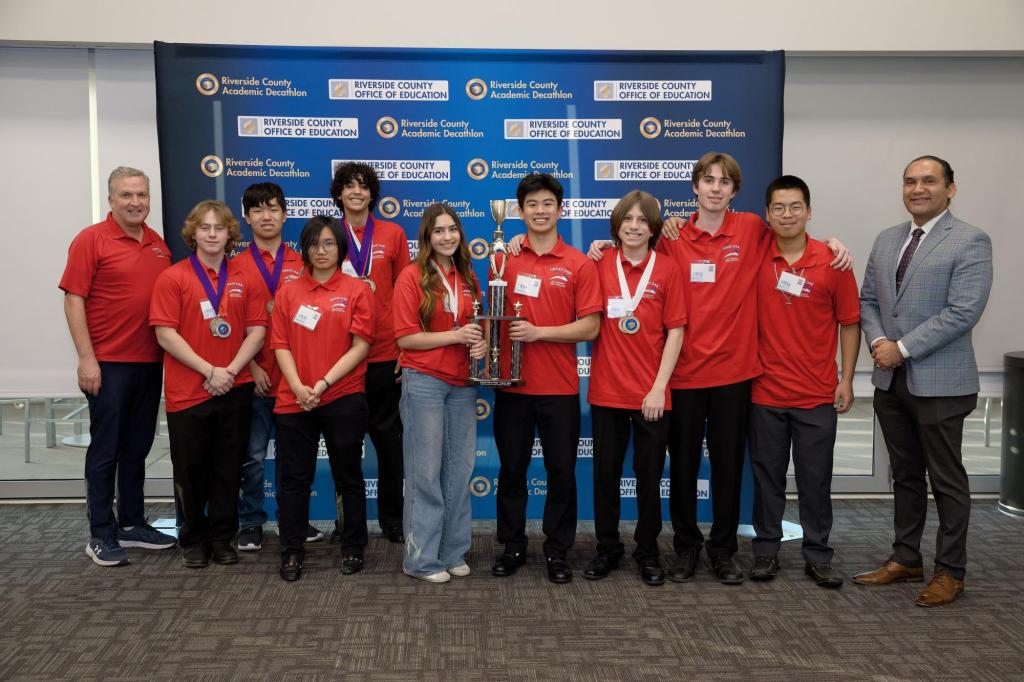
Luke has been part of the team since his sophomore year and stepped into a leadership role this year. Last season, he was Great Oak’s top performer, placing 22nd overall out of 90 in the 2025 Riverside County Academic Decathlon. That year marked one of Great Oak’s strongest showings in team history, finishing 4th out of 11 teams.
What does the Academic Decathlon do on a meeting-to-meeting basis? For example, do you all just spend the meeting taking notes for studying?
Luke: On a meeting to meeting basis, we get together and cover the material as a group. This could mean doing games or making slideshows. We review content together and make sure everyone’s on the same page. To us, it’s important the club stays light and fun—you learn best when you enjoy what you’re doing.
What kinds of subjects are tested in the Academic Decathlon? Are there any in particular that are your favorites?
Luke: We have ten subjects in total. These include core school subjects like math, science, and history, as well as others such as economics, music, speech, and interview. My favorite is speech—it’s the perfect opportunity to express your thoughts or share something you’re passionate about on a higher level.
What do the competitions look like in the winter? Are they difficult or stressful?
Luke: Our competition takes place over two days. On the first day, we meet at Great Oak and take individual multiple-choice tests. Those can be a bit stressful, but with all the food we bring— and the fact that we’re doing it together, it becomes a fun experience. On the second day, all the school teams meet at a conference center for a big Spider-Man-style “Super Quiz.” We also get food and deliver our speeches and interviews. That day is honestly some of the most fun I’ve ever had with my peers.
Are there any kind of qualifications that are necessary to participate? (i.e. minimum GPA requirements, other pre requisites, etc.)
Luke: Not at all! In fact, we actually need students with lower unweighted GPAs.The way teams are structured, we’re required to have competitors in lower GPA brackets in order to compete. Since the higher GPA category is usually overpopulated, we need students with lower GPAs!
What kind of time commitment is necessary for this club?
Luke: The only truly important time commitment is showing up to meetings! Studying outside of club hours is appreciated and definitely helpful, but it’s not required. The only extra time commitment is preparing your own speech—but if you’re passionate about it, it’s much easier than you’d think.
Why would you recommend someone join this club over other seemingly more “fun” clubs?
Luke: There’s no club I’ve ever had more fun in. The name “academic” tends to scare people off, but we honestly have more fun than any other club. It’s just like any other “fun” club, except we also get medals and something great to put on college applications. We really make sure the club doesn’t get bogged down in unnecessary seriousness.
What do you hope for new people joining this club to gain from this experience?
Luke: I hope new members find a great place to make friends, have a good time, and learn some interesting things along the way. Learning doesn’t have to be boring—it can actually be a lot of fun when you’re with people you enjoy spending time with.

Pictured left to right: Luke Johnson, Bruno Martinez, Thomas Park (that’s me!) winning awards at the 2025 Riverside County Academic Decathlon
The club has already begun meeting and reviewing material for the upcoming 2026 competition—but don’t let that deter you! The Academic Decathlon team is always looking for new members. The team meets every Tuesday and Thursday after school from 3:30 to 5:00 in the art room across from the WSB room.
I hope you’ve learned a bit about what Academic Decathlon is all about, and if you decide to join us for the 2026 season, I can’t wait to see you there!
 Great Oak Gazette
Leave a comment