Pranidhaan Chincholikar ’29
It came as a complete shock to everyone waking up on January 3rd to discover the news that Nicholas Maduro had been captured in an overnight U.S. military operation. Despite only being a few days into the year at that point, we had no idea how any military operations like Venezuela would happen in the following months. Although, in retrospect, the signs were quite obvious.
First off, the US is no stranger to regime changes and occupying foreign countries. It has been performing these kinds of operations since the 1890s and often does so for a multitude of goals and reasons. Whether controversial or not, the US has been everywhere—from Asia, Europe, the Pacific, the Middle East, and even Latin America.
While the goals and exigencies of these operations are diverse, the results in the countries occupied are often the same. The U.S. has been known to change the administration or political figure in power; their replacement is regularly U.S.-favored and backed, serving the U.S.’s best interests in the country. Moreover, the United States is known to instill a military presence in the country, building military bases and either taking the reins of a government or supporting a U.S.-friendly government.
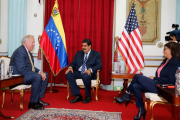
Since Nicholas Maduro’s capture, it feels as if we don’t 100% know what the United States is going to do until after they’ve started military operations. It’s why many felt that the recent conflict with Iran had come out of nowhere, being announced by President Trump as the bombs had already started dropping. However, conflicts between Iran and Venezuela against the United States had been escalating for months (and to an extent, years) prior to military action.
With Iran and Venezuela, relationships with the United States had always been a bit rocky in recent years. In the case of Venezuela, Donald Trump (in his first term) denounced and charged Maduro of having connections to cartel activity happening in the Caribbean Sea, which later inspired the missile strikes on cartels in the Caribbean in late August of 2025. Coupled with all that was the breakdown of the diplomatic relationship, not to mention the interest in Venezuelan oil, which has the largest reserves in the world.
While Operation Southern Spearhead continued on, blockades were issued. Venezuela began its response as it launched Operation Sovereign Caribbean 200, which was a direct response to U.S. encroachment on the Caribbean. Tensions would continue to escalate until the capture of Nicholas Maduro and his wife during Operation Absolute Resolve, indicting him on charges of narcoterrorism. He is currently being tried in the U.S., with the Venezuelan foreign minister questioning the legality of the arrest and demanding his return.
In the case of Iran, relations with the United States have been rocky at times—and have been since the 1980s—with events such as the U.S. embassy being taken hostage by Iranian student revolutionaries. Or, in the 2000s, there was widespread concern over Iran’s nuclear programs.
However, on a more recent note, in December 2025, protests against corruption and the demand for fundamental change in the government broke out and continued throughout January and February. In January, Trump had publicly stated that he would get involved and warned of “very strong action” if Iran didn’t stop its crackdown on the protestors
On February 28th, about two weeks ago at this point, the U.S. military began deploying forces to Iran, unleashing a multitude of bombings on the region. These early bombings targeted military sites and the Supreme Leader, Ayatollah Ali Khamameni, who was later confirmed to be killed by the strikes. The conflict is still escalating as the Middle East, and specifically Israel, receives pushback in the form of missiles coming from Iran, leaving millions in the region in further danger.
Khanameni’s son, Mojitaba Khamaneni, rose to his father’s position, vowing vengeance against the United States, which had killed his father and his mother in the initial strikes on Tehran. However, Trump responded to his new position negatively, stating that “we think it’s gonna lead to just more of the same problem.”
Looking at all of this recent political drama, it’s not exactly hard to start asking questions behind the reasoning for these attacks and recent regime changes. One major purpose is the change of regimes, as Washington views these governments as dictatorial in nature. Nicholas Maduro has been accused by the Venezuelan Congress and other countries of election fraud, especially in the recent July 2024 election, in which he was reelected.
The reaction by Venezuelans to the capture of Nicholas Maduro contained hope and uncertainty, as one Venezuelan described it as seeing “light at the end of the tunnel again.” However, loyalists of Maduro, in the streets or in the Venezuelan Congress, have actively protested and resented the capture of Maduro, seeing it more as a “kidnapping.”
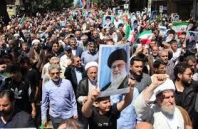
Reactions by Iranians to the death of Ayatollah Khamaneni have also been split, but more vocal than Venezuelan reactions to Nicholas Maduro’s capture. Iranians, jubilant or mournful of Ayatollah’s death, are both concerned for the future of Iran, worrying about potential “consequences and future developments.” So, while many pro-government Iranians mourned the loss of Ayatollah, others erupted in joy and protest at the death of a leader who stood for repression.
Apart from regime changes, one immediate factor in these operations in Iran and Venezuela was the attainment of oil. With the invasion of Iran, oil prices have gone up, leading the average consumer to see the rise in gas prices. In Venezuela, Trump has been instituting oil executive control of Venezuelan oil, arguing that the efforts are for the continued affordability of oil and gas.
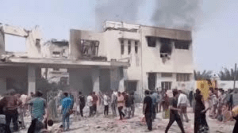
There is, of course, the obvious consequence of these military operations—that being mortality. During Operation Absolute Resolve, the only reported casualties were guards for Maduro, consisting of Venezuelan security officers and intelligence personnel. However, in Iran, there is the infamous case of the elementary school that was bombed while in session during the initial strikes on Tehran. The investigation into what may have caused this horrific event to occur is still underway.
To conclude, with the developing situation in Venezuela and especially in Iran, only time will tell what happens next for these places, as well as what the Trump administration plans on doing next with these countries, and whether they plan on continuing this behavior in other nations. With the conflict still awry and many wondering what’s next, it’s crucial we be on the lookout for what’s on the horizon.
 Great Oak Gazette
Leave a comment